

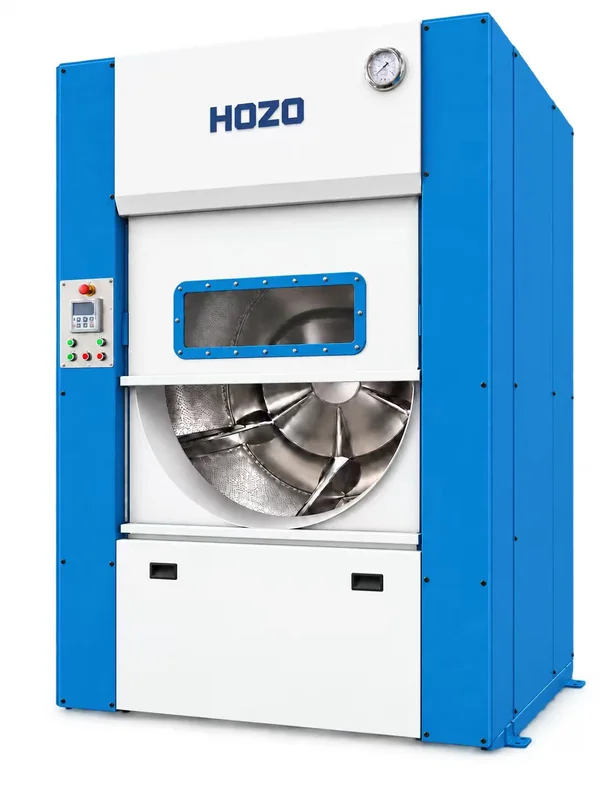
Industrial Tumble Dryers, 30 to 100 kg
HOZO builds two lines of tumble dryer: the HG series in 30 kg, 50 kg and 100 kg, and the HSG-100. Both are open-exhaust, and we do not make condenser dryers. Heating is chosen on the order: steam, gas (LPG or natural gas), or an electric-heated build on the HG series only.
Tumble Dryers Series
HG Series Tumble Dryers
The HG is the standard machine: 30 kg, 50 kg and 100 kg, with drums of 650, 1,056 and 2,064 litres turning both ways at 34, 32 and 28 rpm. We recommend loading the HG lighter, so towels have more room to tumble, and its air is heated indirectly, which is gentler on cotton: terry loops stand up and towels last longer. That is why hotel bath towels go to the HG. The HG-100 draws and exhausts air through two spiral air ducts, each with its own 1.5 kW fan.
Build, Airflow and Energy
Both series run on 3-phase 380 V, reverse their drums during the cycle and push exhaust air into the room’s ducting. What changes between them is airflow: the HSG feeds steam straight into the drum and moves more air, the HG moves less. That decides which machine suits which laundry.
Steam heat is directed straight into the inner drum rather than around the outer shell, the change behind its roughly 40% higher thermal efficiency.
HG: 30, 50 and 100 kg. HSG: 100 kg. Larger sizes are built to order.
We do not build condenser dryers. Every HG and HSG pushes exhaust air through a duct, so plan the duct first.
Same 45 minutes: the HSG-100 dries 100 kg of towels, the HG-100 dries 60 kg, on about 100 kg of steam against about 80 kg, so the HSG uses about a quarter less steam per kilogram of towels. The HSG is the heat-recovery series.
Drums turn both ways and reverse during the cycle: 28-34 rpm on the HG, 30 rpm on the HSG-100.
HG: steam, gas (LPG/NPG) or electric. HSG: steam or gas only, no electric-heated HSG.
HG Sizes and Heating Options
Fan, drum drive and controls draw about 5.2 kWh on the HG-100, 2.6 kWh on the HG-50 and 1.5 kWh on the HG-30, and those figures barely move whichever heating source you order. Heating moves your running cost: 90-120 kg of steam an hour, or about 6 m³/h of gas.
Industrial Tumble Dryer Applications
Hotel Laundry Solutions
Bath towels and bed linen are what a hotel laundry dries, and loft is what guests feel. That is HG work: lower air speed, terry loops left standing. Where steam is cheap and volume is all that counts, the HSG-100 is the alternative; for towels we point to the HG.
Healthcare Facility Drying Systems
Hospital linen is dried for turnaround, not loft, so the HSG-100 fits: 100 kg in a 45-minute cycle, 8,000 m³/h of exhaust.
Commercial Laundry Equipment
Commercial laundries drying mixed loads all day watch the steam meter more than towel loft. That is where the HSG-100 earns its place: 100 kg per 45-minute cycle on 100 kg of steam, where the HG-100 dries 60 kg on about 80 kg in the same time.
Central Laundry Plants
A plant measuring its day in tonnes cares about cost per kilogram, so these come in rows: HSG-100, 100 kg a cycle, 100 kg of steam, 8,000 m³/h of exhaust. Where the plant also handles fine work, add an HG for towel loft.
Matching Dryer Capacity to Volume
Choosing a tumble dryer is not only a question of kilograms. Cycle time, airflow, heating source and floor space decide how many machines a laundry needs.
Two series, two philosophies. HOZO Laundry offers the HG Series (standard tumble dryer) and the HSG Series (forward-air energy-efficient dryer). They serve different priorities:
| Performance (100 kg class) | HSG Series | HG Series |
|---|---|---|
| Towels dried in 45 min | 100 kg | 60 kg |
| Steam per kg of towels | about 1.0 kg | about 1.3 kg |
| Heating method | Forward-air direct into drum (+40% thermal efficiency) | Upward airflow, indirect heating through the outer shell |
| Fan system | Variable frequency 5.5 kW (smart speed control) | Dual motors 1.5 kW × 2 |
| Insulation | Wool felt insulation (sealed, dust-proof) | Wool felt insulation |
| Best for | High-volume plants prioritizing energy cost per kg | Operations prioritizing fabric softness and fluffiness |
Choose the HSG where steam cost per kilogram drives the decision, and the HG where towels must come out fluffy. Heating: HG steam, gas or electric; HSG steam or gas only. Sizes: HG 30, 50 and 100 kg; HSG 100 kg; larger on request.
Which series fits your operation? It depends on your priorities. Tell us your daily volume and fabric types →
Dryers in Service Worldwide
Where our dryers are running:
- Indonesia — 2 × HG-100 with 4 washers, wash and dry throughput matched
- Saudi Arabia — 4 × 100 kg dryers for a 5-star hotel group, 5,000 kg a day
- Thailand — 4 × 100 kg dryers in a hospital infection-control laundry
- Nigeria — 2 × 50 kg dryers for a new commercial laundry, remote commissioning
Industrial Tumble Dryer FAQ
Two lines sold side by side, not an old model and a new one. The HSG-100 feeds steam straight into the drum and moves more air, drying 100 kg of towels in 45 minutes on 100 kg of steam. The HG-100 dries 60 kg in the same 45 minutes on about 80 kg, loaded lighter and heated indirectly, which keeps terry towels fluffy.
Per kilogram of towels, the HSG: about 1.0 kg of steam against about 1.3 kg on the HG-100, roughly a quarter less.
HG-30, HG-50 and HG-100, at 30, 50 and 100 kg. The HSG is 100 kg only. Anything larger is built to order, so give us the batch size and daily volume in kilograms.
Yes, as the T variant: HG-30T, HG-50T and HG-100T open in two halves. The HSG-100T also tilts, which makes loading and unloading easier. Everything else matches the standard model, and every T variant loads and unloads from the same side.
Yes. Every HG and HSG can be ordered for gas, LPG or natural gas, about 6 m³/h on a 100 kg machine at 0.05-0.08 MPa. The HG can also be built with electric heating; the HSG cannot.
Yes. Every HG and HSG is open-exhaust, not a condenser dryer, so the room needs an outlet that can carry the air away: 6,000 m³/h on the HG-100, 2,400-3,000 m³/h on the smaller HG sizes, 8,000 m³/h on the HSG-100.
Every machine ships with full documentation, commissioning instructions and operator training material, plus technical support by video call for the life of the machine at no charge. Installation and routine maintenance are handled locally: your own maintenance team, a local partner, or our engineers travelling to your site when a project calls for it, with travel quoted separately.