 English
 Español


Before industrial laundry equipment arrives, the site needs six things in place: a three-phase power supply sized for every machine, water at the right pressure, drainage that can take a washer’s full dump, a heat source (steam, gas or electric), clean dry compressed air, and exhaust ducting for the dryers. On top of that, the floor has to carry the weight and there has to be a way to get the largest machine into the room. Most installation delays come from one of these being discovered missing on delivery day.
The connection figures below are from our own machines, and the warnings come from mistakes we and other laundry engineers keep running into on site. For zones and workflow, see the commercial laundry plant layout guide.
Why site preparation decides your start-up date
Machines can be built in 10 to 15 days, but a drainage trench, a three-phase supply or a boiler permit can take months. If the building work starts only when the equipment ships, the machines sit in crates while the contractor catches up. Ask your supplier for the installation drawings of every machine at the order stage, hand them to your contractor, and treat the items below as a checklist to close before the container arrives.
Electrical supply
Industrial laundry machines run on three-phase power. Our standard machines are built for 3-phase 380 V, 50 Hz, and the supply voltage can be customized, so give your supplier your local voltage and frequency at the order stage.
- A dedicated circuit and isolator for each machine, with the breaker rating from the machine’s data sheet.
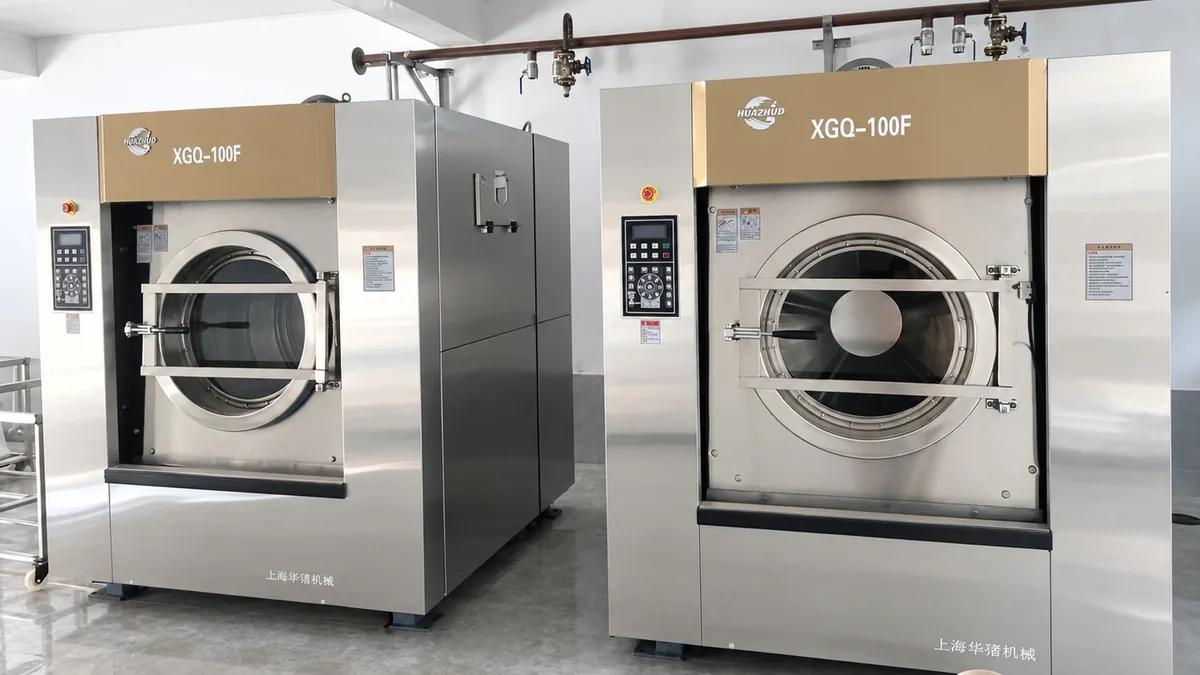
- Cable sized for the heating type. Electric heating multiplies the current. For a 100 kg washer extractor, the supply cable is 3 × 6 + 1 × 4 mm² for a steam-heated machine, but 3 × 25 + 1 × 16 mm² for an electrically heated one.
- Total capacity at the distribution board. Add up every machine, the air compressor, lighting and ventilation. Electric dryers and ironers can push a small plant’s demand from tens of kilowatts to several hundred.
- A proper earth. Folders and stackers are sensitive to static from dry linen. Laundry engineers recommend an earth rod driven at least 1.5 m deep; in dry ground, keep the soil around it damp.
Water supply
Washer extractors fill quickly, and a weak supply stretches every cycle.
| Washer extractor | Water inlet | Inlet pressure | Water per cycle (1 wash, 2 rinses) |
|---|---|---|---|
| 15 to 25 kg | 2 × DN20 (3/4″) | 0.2 to 0.3 MPa | 210 to 400 L |
| 30 to 50 kg | 2 × DN40 (1.5″) | 0.2 to 0.3 MPa | 480 to 800 L |
| 100 kg | 2 × DN50 (2″) | 0.2 to 0.3 MPa | 1,500 L |
Plan the main so that several washers can fill at the same time without the pressure falling below 0.2 MPa. Most plants also need water softening: hard water wastes detergent, greys the linen and scales the heating system. If you have a boiler, its feed water must be softened in any case.
Drainage
Drainage catches out more new plants than anything else, because a washer extractor does not drain slowly. It dumps a full bath in seconds.
- Drain size. Our 30 to 100 kg washer extractors have a Ø140 mm drain outlet; 15 to 25 kg machines have Ø76 mm.
- A trench, not a floor drain. In front of or behind a row of washers, build an open trench with a removable stainless steel grating, sized so that two or three machines can dump at once without flooding the floor.
- A raised plinth with a gutter. A common detail in well-run plants is a plinth about 12 cm high under the washers, with a gutter around it, and a low kerb in front to stop linen trolleys hitting the machines.
- Lint. Washer drains carry lint. Put a lint screen or settling pit before the drain joins the building sewer, and check local discharge rules if you wash healthcare linen.
Heat source: steam, gas or electric
Each heating type has its own connection.
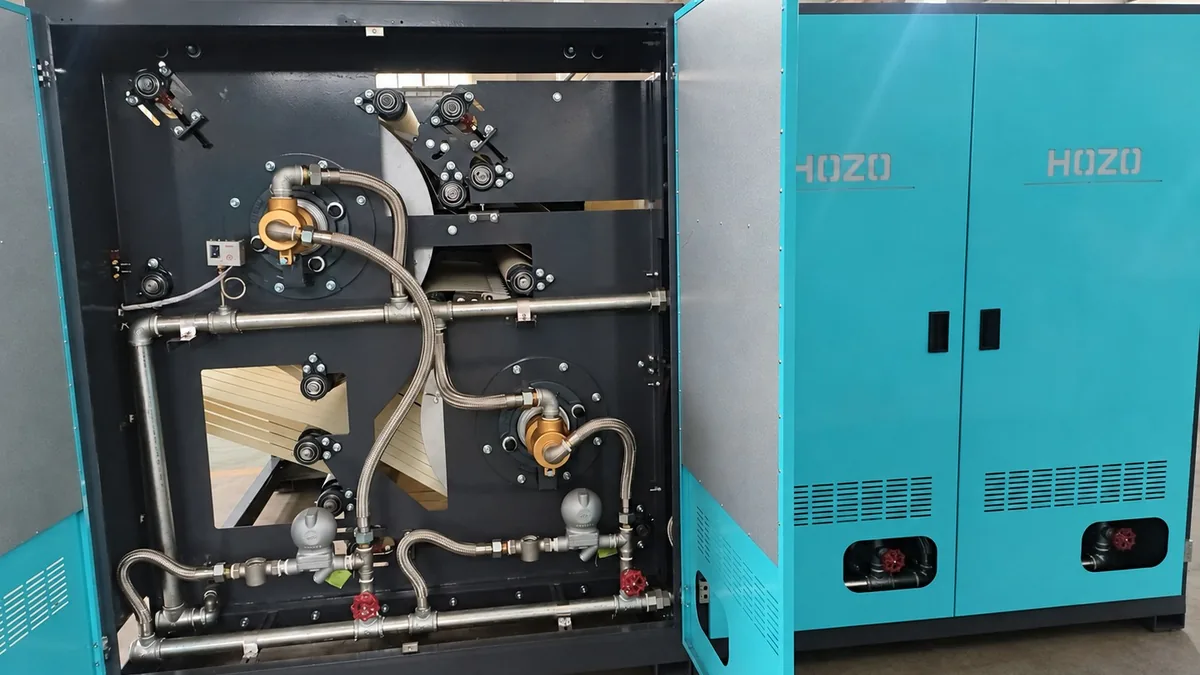
- Steam. Our machines are rated for 0.4 to 0.6 MPa at the inlet. Steam inlets are DN20 to DN25 on washer extractors, DN25 to DN32 on dryers and DN40 on 3.3 m flatwork ironers. Each machine needs a steam trap and a condensate return line. For boiler size and piping, see our guide to commercial laundry boiler sizing.
- Gas. Gas dryers and ironers need a supply at 0.05 to 0.08 MPa and a flow that covers all burners at once, about 6 m³/h for a 100 kg dryer and about 6 m³/h per heated roll on a gas ironer. The gas line is usually installed by the gas utility or a licensed contractor.
- Electric. Covered under power above. Check the cable and the board capacity before choosing electric heating on anything larger than a small washer.
Compressed air
Folders, stackers, feeders and the door and valve actuators on large washers all run on compressed air at about 0.6 MPa. The volumes are small, but the quality matters more than the quantity.
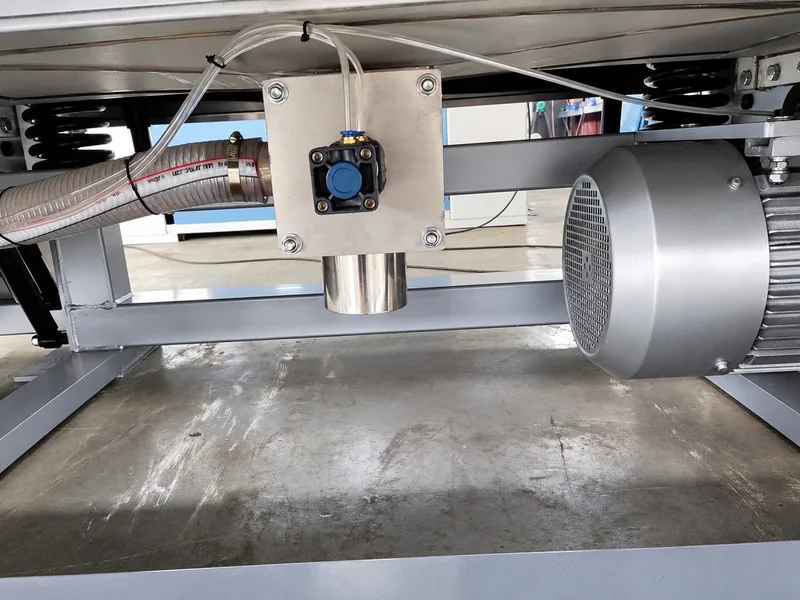
- Size the compressor for the whole plant, then add margin. At high altitude, compressors lose roughly 12% of output for every 1,000 m, so choose a larger unit above about 1,000 m.
- Fit a receiver tank so the compressor is not starting and stopping constantly. A folder that folds unevenly is often a plant without a receiver.
- Dry and filter the air. Use an air dryer with filters before and after it, and automatic drain valves on the tank and filters. Wet air makes cylinders and solenoid valves stick, and oil or water blown onto linen in a folder leaves dark spots that send the piece back to be rewashed.
Dryer exhaust and ventilation
Tumble dryers move a lot of hot, humid, lint-laden air. HOZO dryers need exhaust ducting from Ø240 mm on the 30 kg model up to 300 × 350 mm on the HSG-100, handling 2,400 to 8,000 m³ of air per hour. A badly built duct can slow every load in the plant, so give the ductwork the same attention as the machines.
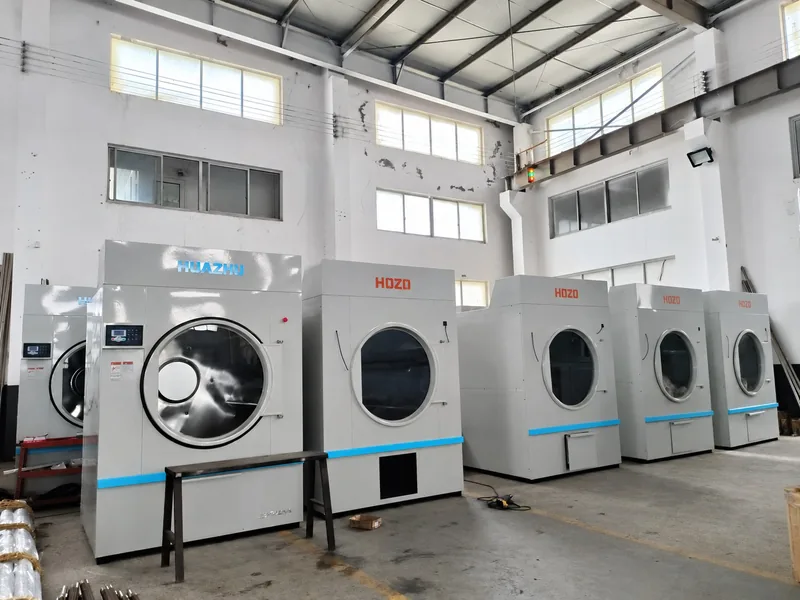
- One duct per dryer, or a properly sized common main. Joining dryers into a main that is too small makes them push against each other.
- Smooth bends, never sharp right angles. Use swept or U-shaped bends and keep runs as short as possible.
- Sheet thickness of 0.6 mm or more, insulated. Thin square ducting rattles, and insulation keeps the heat out of the workshop.
- Heat-resistant, short flexible connectors. On tilting dryers, a long flexible connector can be blown sideways when the dryer returns to position and partly block the outlet, which makes every load slower.
- A lint trap or wash-down in the exhaust main, and a clear cleaning schedule.
Beyond the dryers, the whole workshop needs ventilation. Ironers and dryers release heat continuously, and a hot, humid room wears out staff and electrics. Insulating hot equipment and pipework does as much for room temperature as fans do.
Floor and foundations
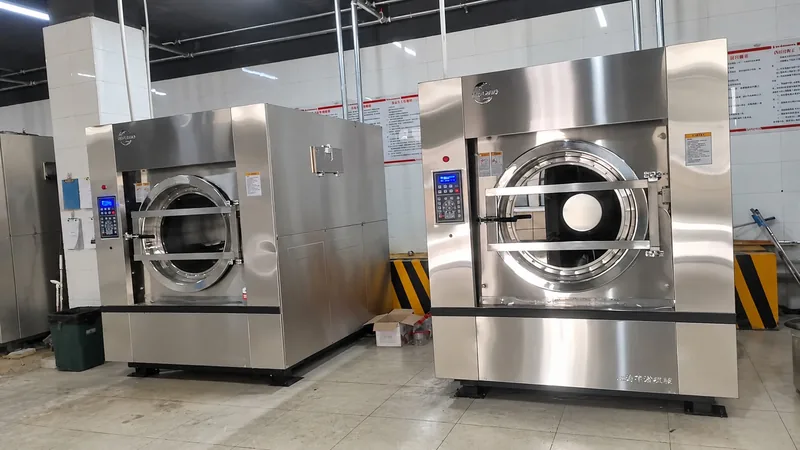
- Load. Laundry machines are heavy and concentrated. Our 100 kg washer extractor weighs 3,250 kg, and a 6-roll 3.3 m flatwork ironer weighs 7,500 kg. Check the slab with your structural engineer, especially on upper floors.
- Level, solid concrete. Washer extractors spin at high G-force, and the usual industry practice is to bolt them to the floor. Our suspended washer extractors can run without anchor bolts in most installations, provided they stand on a level, solid concrete floor. On upper floors, thin or weak slabs, or raised plinths, check with us and your structural engineer first; anchoring may still be the right choice there.
- Surface. The floor sees water, heat and alkaline chemicals every day. Epoxy coating suits refurbishments if the base is sound; a dry-shake hardened concrete floor laid with the slab suits new buildings.
Access, clearance and rigging
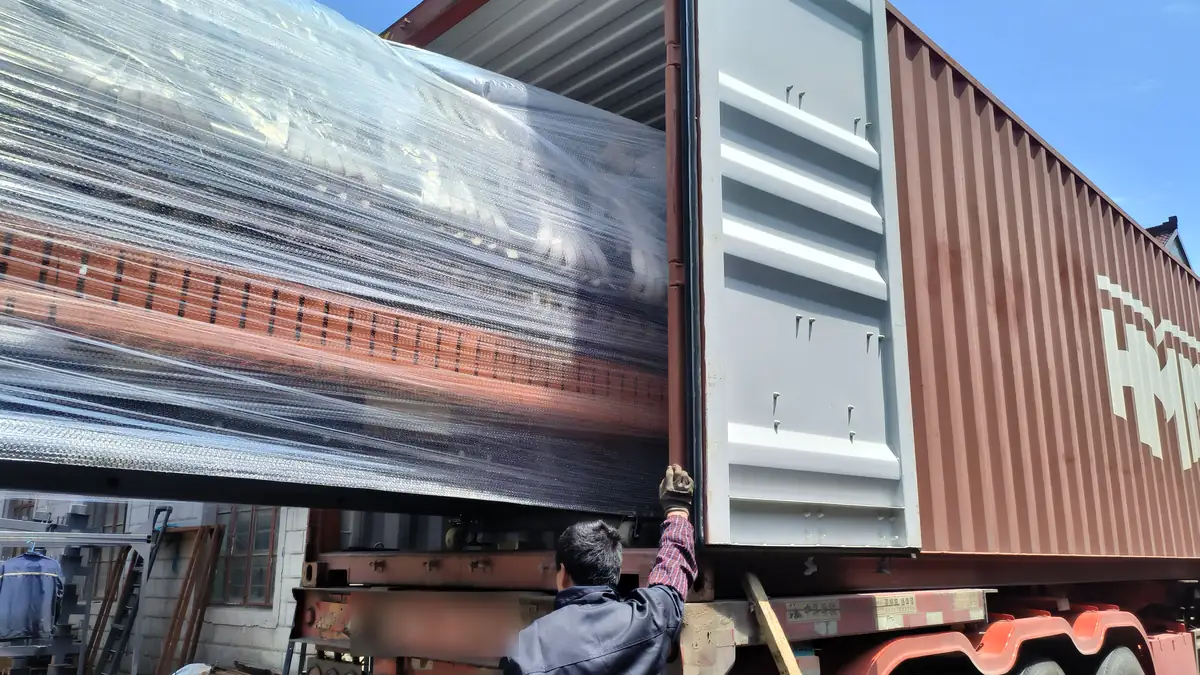
The largest machine decides the size of the door. A 3.3 m flatwork ironer is about 4.5 m long and up to 1.4 m high, and a 100 kg washer extractor is 1.8 × 2.1 × 2.3 m before crating.
- Measure the route from the truck to the final position, including doors, corridors, ramps and lift capacity.
- Plan how the machine will be moved: forklift, crane, or rollers and pry bars. In a crowded old building, a heavy ironer can take most of a day to move into place.
- Leave service space behind washers, where water, drain, air and power connections are grouped, and on both sides of ironers for roll and belt maintenance.
Pre-delivery checklist
| Item | Ready when |
|---|---|
| Power | 3-phase supply, isolator and breaker at every machine position; board capacity checked |
| Water | Mains at 0.2 to 0.3 MPa, softener installed and commissioned |
| Drainage | Trench and grating built, tested with a full dump |
| Steam or gas | Lines run to each position, pressure tested, traps fitted |
| Compressed air | Compressor, receiver, dryer and filters running |
| Exhaust | Ducts installed to each dryer position and out of the building |
| Floor | Level, cured, load checked |
| Access | Delivery route measured against the largest crate |
We send installation drawings for every machine once an order is confirmed, and our engineers are happy to look over your floor plan and utility drawings before the builders start. Get in touch if you would like a second pair of eyes on your site.
Installation questions we hear most
What power supply do industrial washing machines need?
Three-phase power. Our standard machines use 3-phase 380 V, 50 Hz, and the supply voltage can be customized to your grid. Cable size depends on the heating type.
Do washer extractors need to be bolted to the floor?
Bolting is the standard practice. Our suspended washer extractors can run without anchor bolts in most installations on a level, solid concrete floor; on upper floors or weak slabs, anchor them.
What is the difference between soft-mount and hard-mount washer extractors?
A soft-mount machine stands on springs or shock absorbers that take up most of the vibration during the spin, so less force reaches the floor. A hard-mount machine has a rigid frame that has to be bolted to a solid concrete foundation, which takes the spin forces directly. Most industrial washer extractors today are soft-mount, ours included; whichever type you choose, have the floor checked before the machine arrives.
What size drain does a commercial washer extractor need?
Our 30 to 100 kg models have a Ø140 mm outlet and should discharge into an open trench that can take several machines dumping at once.
What compressed air pressure do laundry folders need?
About 0.6 MPa, and the air must be dry and filtered. Wet or oily air leaves marks on the linen.
About the Author: HOZO Engineering Team, with 30+ years of industrial laundry equipment manufacturing experience. HOZO is an industrial laundry equipment manufacturer in Shanghai, China, building washer extractors, tumble dryers, flatwork ironers and finishing equipment for laundries in more than 80 countries.